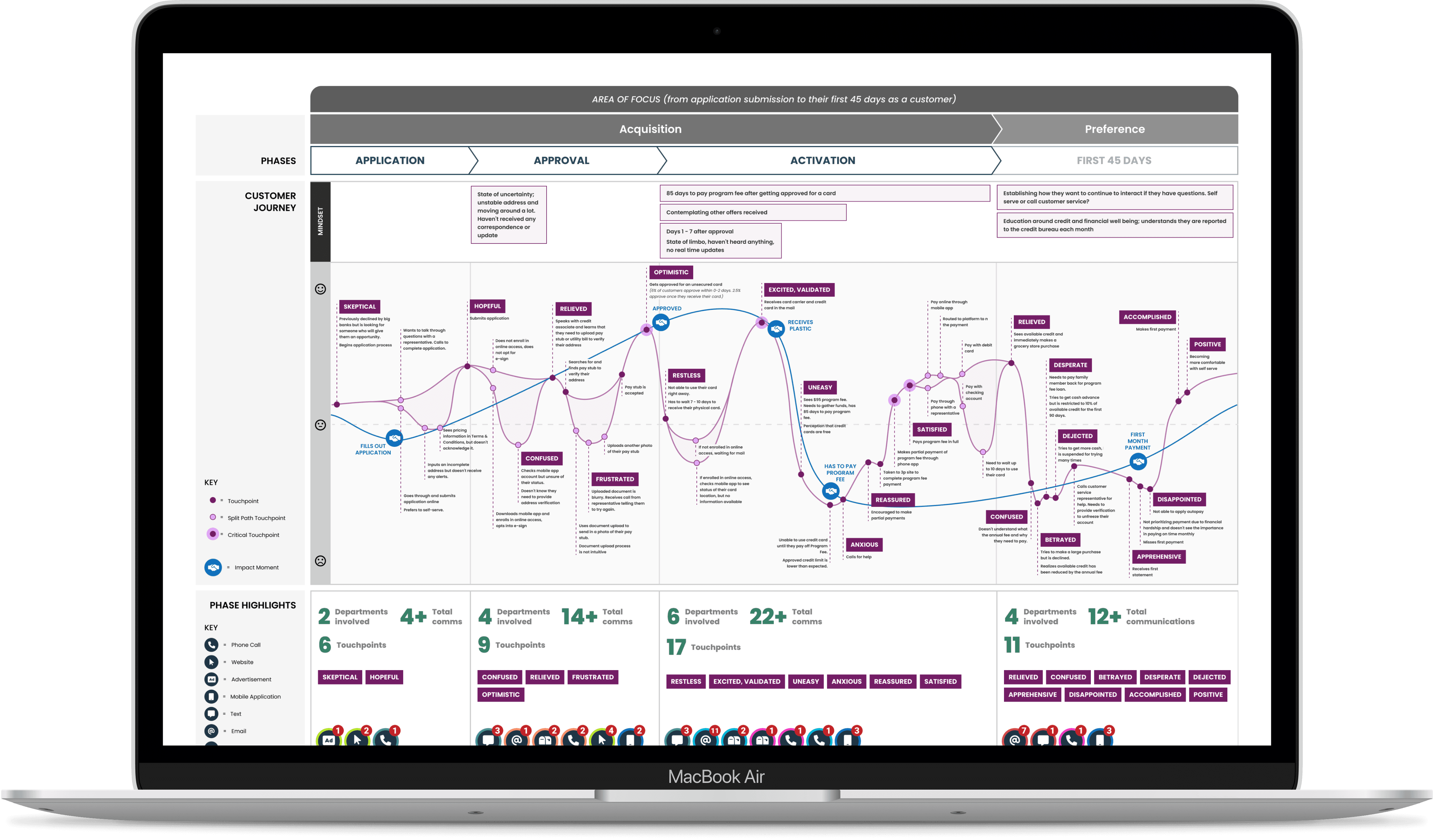
Background
Our client was a banking company (“Bankco”) that specialized in the subprime credit card space. Their customers join Bankco after experiencing financial trauma and need to feel confident and safe in their financial journey. With recent changes in management, Bankco needed help identifying problems with their current work streams
Our goal was to create a journey map that would act as the single source of truth for short term enhancement opportunities and form the foundational knowledge base needed for larger future-state decisions.
As the main researcher on the team, I was in charge of creating interview assets, analyzing and synthesizing all data points, creating initial visuals, and presenting results to internal and external management.
Three Complementing Methods of Research
I used three different research methods to gain a comprehensive understanding of the user's current state journey. Each method provided a distinct perspective but also complemented and validated one another.
1. Use historical research to set the foundation.
2. Interview Bankco's Subject Matter Experts to expand knowledge.
3. Perform heuristic analysis to objectively identify and understand issues.
Use historical research to set the foundation.
Process
I started by analyzing Bankco's existing user research archive, background information, and documentation pertaining to the current state journey.
This early stage research helped me understand the current journey, set the foundation for our analysis, and provide quantitative data.
Findings
4 in 5 applications (~1.2M accounts) fail to become activated customers after receiving credit card approval
50% of approved applicants are unable to pay the fee required to activate the card
20% of applications do not receive an instant decision, with 75% of those applicants failing to complete the review process
Interview subject matter experts (SMEs) to expand knowledge
Process
I conducted interviews with Bankco SMEs to gain insights into their understanding of what happens for the customer at each step of the journey. Without access to users, the SMEs would act as proxy for direct customer input.
I asked questions around interactions of customer touch points and perceived emotions at each journey phase as well as focused discussion points around high impact moments identified by management.
With the end product of a journey map in mind, I used a blank template to help guide the discussion.
Findings
Communication gaps - customers are surprised by fees even though they are disclosed during the process. Lack of visibility, especially for customers in a pending state, leave them in a state of "limbo"
Technology friction - customers report challenges with submitting information and lack of autopay options
Internal misalignment - internal teams are unaware of what others have already communicated
Perform heuristic analysis to objectively identify and understand issues.
Process
To ensure I was providing an objective analysis of any issues, I conducted a heuristic analysis on flows we had access to.
I also supplemented our recommendations with quantitative data from trusted third-party research agencies (e.g., Zendesk CX Trends 2023) and provided recommendations from direct and indirect competitors.
Findings
Opportunities to experiment with how and when product information is displayed
Opportunities to align the application process with design best practices (e.g., inline validation, real-time feedback)
Opportunities to establish the communication process and defining teams responsible for defining and maintaining messaging tone and visuals
Final Journey Map & Visuals
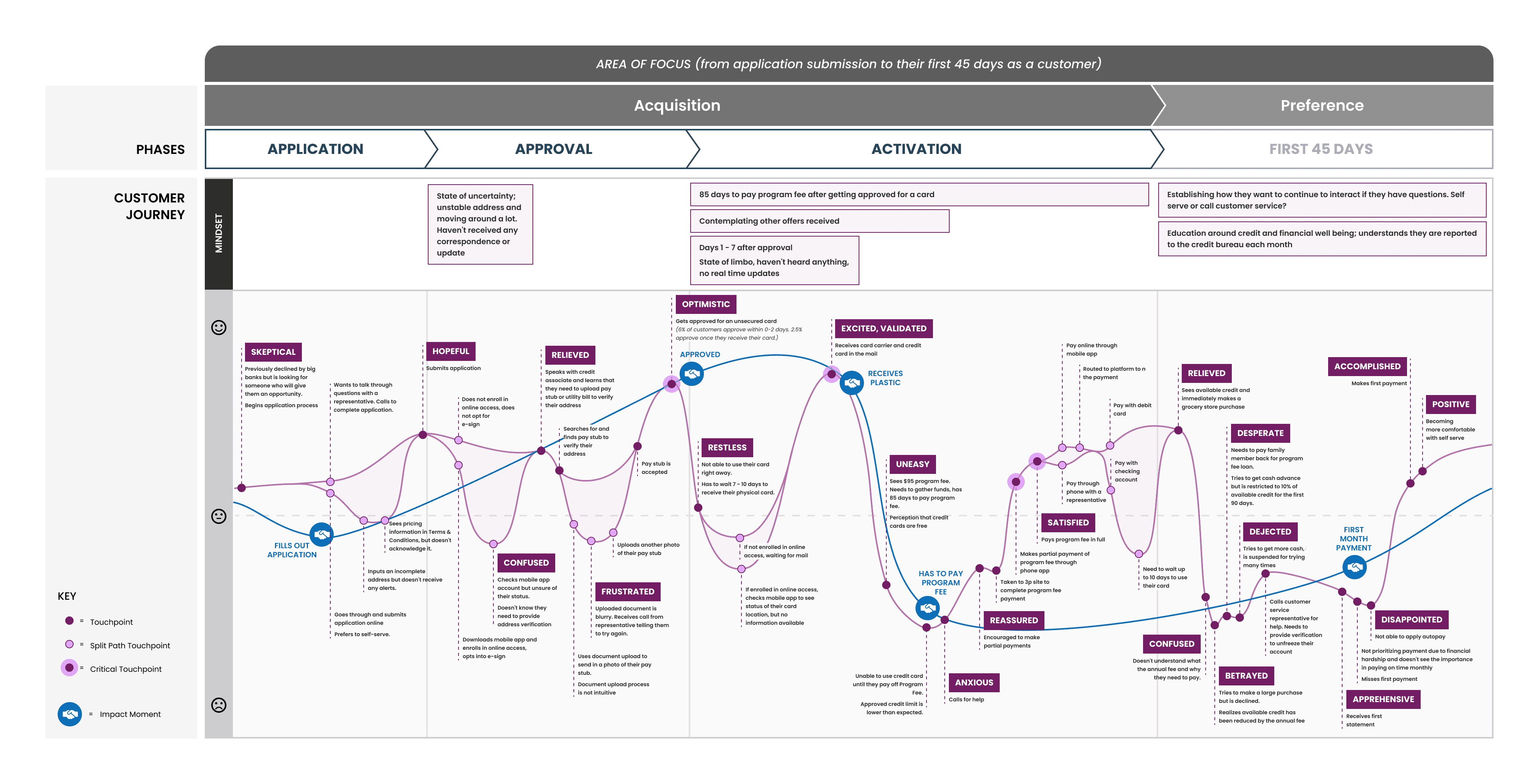
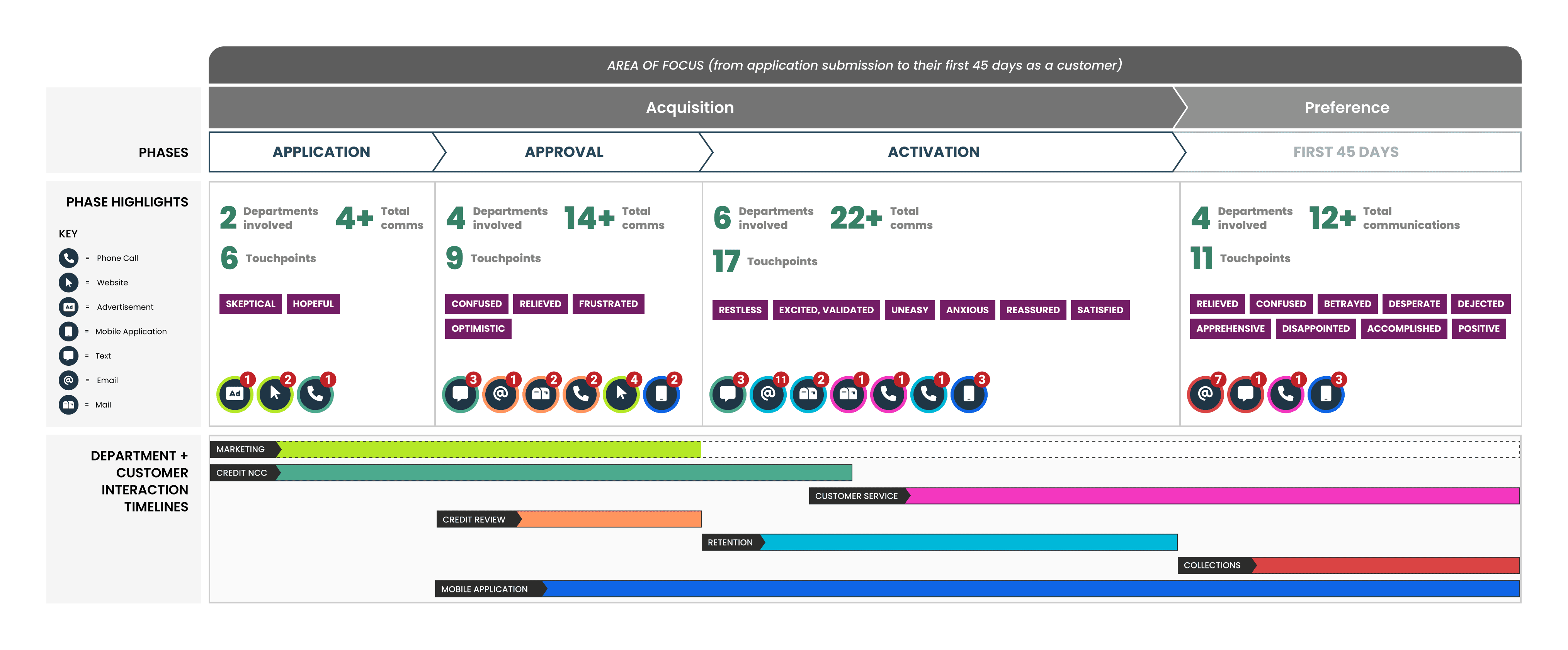
Mapping out the communication process helped visualize team silos and communication touchpoints
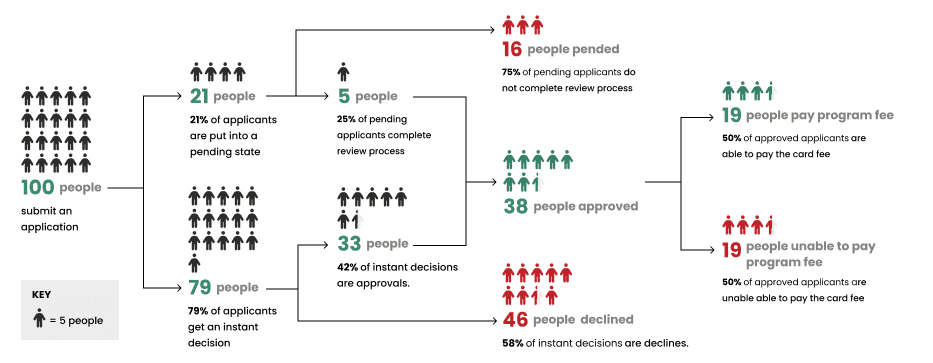
I worked with our visual designer to depict where we saw the biggest friction points and drop-off (shown in red text).
The journey continues
This research project steered Bankco towards a more user-centric approach to product design and build, and proved the concept of journey mapping and the impact it could have for them organizationally.
the end! Return to selected work